 English
 Français
 Español

How the first edition of INPAS was developed
Demand
INPAS was developed in response to global demand.
> What is the evidence of demand for a standard?
Drafting
INPAS was drafted by a competent body, with input from expert advisors.
> Who drafted and approved the INPAS text for publishing?
Stakeholders
INPAS was shaped and refined through public consultations with global stakeholders.
> Was there sufficient input from stakeholders?
Process
INPAS was developed according to a rigorous and transparent process.
> Did it meet the standard for international due process?
IFRS for SMEs
INPAS is based on the IFRS for SMEs accounting standard.
> Were the advantages and disadvantages adequately considered?
Evidence of demand
- Evidence of initial demand for a Standard comes from a 2014 survey
- 72% of respondents from 179 countries agreed that an NPO-specific accounting standard would be useful
The fact that the IFR4NPO project has brought together a community of over 15,000 stakeholders in 169 countries is also indicative of the profound interest.
View the 2014 survey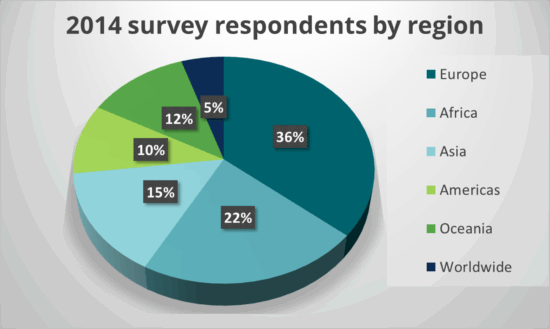
INPAS drafting and approval
For the first edition of INPAS:
- The text was drafted by the INPAS Secretariat
- The Secretariat was hosted by the Certified Institute of Public Finance and Accountancy (CIPFA), one of the IFR4NPO Project partners.
- The text was approved for publication by the Technical Advisory Group (TAG)
- INPAS was published by the International Non Profit Reporting Foundation
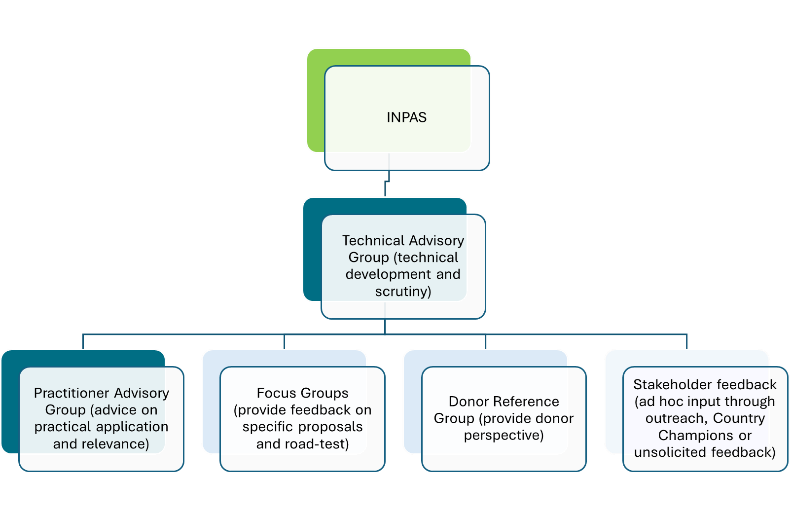
The diagram shows how input from various advisory groups, focus groups and other sources was shared with the TAG.
Stakeholder engagement
There was an unprecedented level of international engagement with stakeholders from all parts of the sector – through webinars, public events and focus groups.
- Particular effort was made to include voices that are often underrepresented in standard-setting.
- Especially civil society organisations and those in low- and middle-income countries.
The stakeholder engagement process was led by Humentum, one of the IFR4NPO Project partners.
16,000
Event registrants
138
Countries
133
Events
Due process
Due process refers to the steps, inputs, and oversight involved in developing an international accounting standard – see the icons below.
It is iterative, involving multiple stages of feedback and refinement.
The IFR4NPO Project Governance Group endorsed the due process followed in the development of INPAS, concluding that:
- Consultation papers, draft versions of INPAS (exposure drafts), meeting notes and other relevant documents were published.
- Diverse regional contexts and challenges were reflected, as a result of targeted outreach, translated materials and inclusive consultation methods.
- The process was robust, appropriate and properly carried out.

Expert input
Standing groups provide technical and practical advice on proposals.

Consultation
Explanatory materials and outreach events support stakeholder engagement.

Feedback
Stakeholders submit written comments in response to questions in public documents and targeted focus groups provide considered input.

Analysis
Responses are reviewed in detail, identifying recurring themes and issues.
Why use IFRS for SMEs as the starting point?
The Consultation Paper set out a number of options, together with analysis of the advantages and disadvantages of each, from a range of stakeholder perspectives.
On balance, the IFRS for SME Accounting Standard was considered a pragmatic choice for the reasons shown below:
View webinar about use of IFRS for SMETrusted framework
International standards developed through a global due process are more widely adopted and trusted.
More appropriate than IPSAS
While IPSAS offers potentially relevant guidance for NPOs, its complexity contrasts with the IFRS for SMEs Accounting Standard®, which is single, shorter, and more stable standard.
Consistency
Many user needs and transactions are shared across for-profit, non-profit, and public sector organisations.
Rapid and relevant
Adapting the IFRS for SMEs Accounting Standard® enabled rapid development of a comprehensive NPO standard, with modifications reflecting the sector’s unique context.